In your home
Your instructor drives to you. No car line, no parking structure, and the student practices on the exact instrument they'll play all week.
Bass lessons
Every band needs one bass player and most of them cannot find one. It is the shortest path from beginner to actually playing with other people, which happens to be the single strongest predictor of whether someone is still playing music in five years.
One note at a time, four strings, and a part that is simple enough to play correctly within weeks but deep enough to spend a career on. A bass student can hold down a real song at the end of month two. A guitar student at month two is usually still fighting chord changes. If the goal is to get a teenager into a band, bass is the fastest route there.
The bass player's actual job is time. Not speed, not range — time. That means a metronome is in every lesson from the first one, and that we spend real effort on where in the beat a note sits, because playing slightly ahead or behind is the difference between a groove and a mess. This is teachable and most self-taught players never work on it.
Electric bass and upright are related the way a car and a motorcycle are related. Both get taught here. Upright is standard for jazz and school orchestra programs and asks considerably more physically — sizing and setup matter enormously, and we will get that right before technique work begins.
Tab is fine and every bass player uses it. It is also incapable of expressing rhythm, which is the instrument's entire job. We teach standard notation alongside it, in small amounts, because a bassist who reads gets called for pit orchestras, church gigs and school ensembles, and one who does not, does not.
Where lessons happen
Your instructor drives to you. No car line, no parking structure, and the student practices on the exact instrument they'll play all week.
Live video, one-on-one. Genuinely effective for piano, guitar, ukulele, voice and theory — and the one format a heat wave can't cancel.
A dedicated room with a tuned acoustic piano, a full kit and amps — the right setting for recital prep and for students without gear at home.
Serving Long Beach · Irvine · Pasadena · Huntington Beach and the rest of Southern California.
Also taught
Families take more than one instrument from us all the time, on the same schedule and often with the same instructor.
Acoustic and electric. Chords and songs from week one, with theory folded in as it becomes useful rather than as a prerequisite.
The clearest map of how music is built. Classical, pop and contemporary, with reading and ear training taught side by side.
Groove, independence and reading. We can start on a practice pad or an electronic kit if a full setup isn't realistic at home yet.
Posture and tone first. Suzuki-friendly, school-orchestra aligned, and open to fiddle and film-score repertoire when that's the motivation.

Breath support, pitch, range and stamina — plus the practical nerve it takes to sing in front of an audition panel or a room.
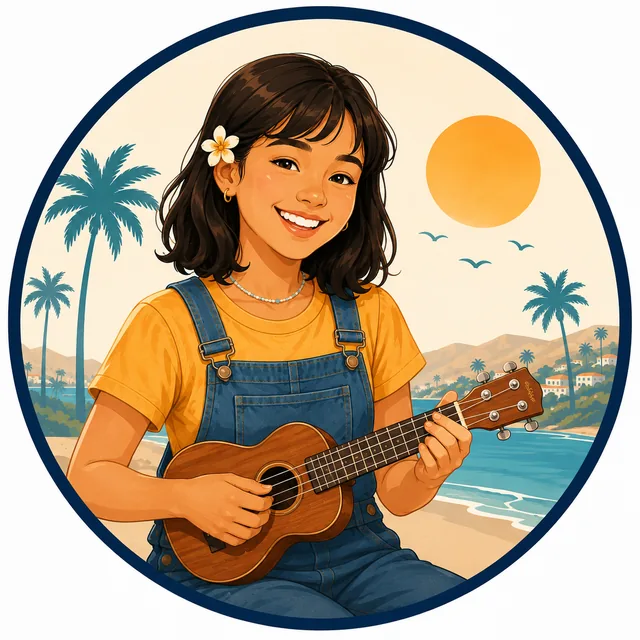
Four strings, soft nylon, and a real song on day one. The gentlest first instrument we teach, and a favourite with adult beginners.

Small-group play-alongs for students already taking lessons. Counting someone else in is a different skill from playing alone.
Questions
No. They are separate instruments with different roles and different technique. Starting directly on bass is completely normal.
Short-scale electric basses (around 30 inches) fit players from roughly age eight to twelve comfortably. Upright basses are sized like violins, from 1/8 up.
Eventually, but not for the first lessons. A small practice amp or a headphone amp is plenty for the first year, and quieter for everyone else in the house.
Start here
It goes straight to our inbox. We read every one and reply within one business day with an instructor, their background and the rate sheet.
Rather talk it through? (909) 375-8728